
ABONNEZ-VOUS À NOTRE NEWSLETTER
Newsletter - Bulletin d'information
Restez informé des sujets qui touchent l'architecture d'entreprise et l'architecture métier, et découvrez comment les services de Business Architecture Info sont utilisés pour apporter de la valeur aux architectes d'entreprise et aux architectes métier dans divers secteurs, grâce à notre newsletter publiée au moins une fois par mois.
L’illusion de l’alignement — et comment l’architecture d’entreprise peut combler l’écart
Les deux auteurs travaillent depuis de nombreuses années dans le domaine de l'architecture d'entreprise, sur différents continents et dans divers contextes organisationnels. Leurs parcours se sont croisés à plusieurs reprises, notamment dans les secteurs de l'automobile et de la logistique, au sein d'initiatives d'architecture d'entreprise et de gestion façonnées par des défis de transformation complexes.
Ces échanges répétés ont révélé une observation commune. Les deux auteurs ont examiné le même problème fondamental sous des angles complémentaires. Daniel l'a abordé sous l'angle de l'architecture d'entreprise, en mettant l'accent sur les capacités, les flux de valeur et la clarté structurelle ; Abebe, quant à lui, a adopté une perspective plus large, celle de la DSI et de la transformation, centrée sur l'exécution de la stratégie et sa mise en œuvre concrète dans des environnements à grande échelle. Malgré leurs points de vue différents, les auteurs ont constamment constaté le même problème sous-jacent :
Pourquoi les organisations qui semblent parfaitement alignées sur le papier
échouent-elles si souvent à atteindre les résultats escomptés ?

L’illusion de l’alignement — et comment l’architecture d’entreprise peut combler l’écart
Les deux auteurs travaillent depuis de nombreuses années dans le domaine de l'architecture d'entreprise, sur différents continents et dans divers contextes organisationnels. Leurs parcours se sont croisés à plusieurs reprises, notamment dans les secteurs de l'automobile et de la logistique, au sein d'initiatives d'architecture d'entreprise et de gestion façonnées par des défis de transformation complexes.
Ces échanges répétés ont révélé une observation commune. Les deux auteurs ont examiné le même problème fondamental sous des angles complémentaires. Daniel l'a abordé sous l'angle de l'architecture d'entreprise, en mettant l'accent sur les capacités, les flux de valeur et la clarté structurelle ; Abebe, quant à lui, a adopté une perspective plus large, celle de la DSI et de la transformation, centrée sur l'exécution de la stratégie et sa mise en œuvre concrète dans des environnements à grande échelle. Malgré leurs points de vue différents, les auteurs ont constamment constaté le même problème sous-jacent :
Pourquoi les organisations qui semblent parfaitement alignées sur le papier
échouent-elles si souvent à atteindre les résultats escomptés ?

De l'architecture statique à un moteur de décision
basé sur l'IA
Dans notre récente newsletter et notre document technique, nous avons exploré l'évolution nécessaire de l'architecture d'entreprise (AE), d'une documentation statique à un système vivant, grâce à l'adoption d'un flux de travail AE de bout en bout, basé sur l'IA. Dans ce modèle, le modélisateur AE traditionnel devient un orchestrateur d'IA.
Cet article apporte un éclairage supplémentaire, volontairement omis du document technique : l'architecture de plateforme sous-jacente qui rend cette transformation possible.
Une fonction AE basée sur l'IA n'est pas simplement un meilleur outil ou un tableau de bord plus intelligent. Elle requiert une approche architecturale fondamentalement différente. Surtout, nous abordons la mise en œuvre de cette architecture de manière agnostique, en collaborant avec nos clients pour répondre à leurs besoins techniques tout en tirant le meilleur parti possible de leurs investissements existants. Il ne s'agit pas de remplacer ces investissements, mais de les orchestrer et de les transformer en un outil bien plus puissant : un moteur de décision basé sur l'IA.
Trop d'organisations tentent d'intégrer l'IA à des plateformes telles que SAP LeanIX ou Ardoq. Bien que ces plateformes demeurent importantes, elles ne constituent qu'un élément d'un système plus vaste et structuré en couches.

Accélérateur de documentation d'architecture d'entreprise basé sur l'IA (édition 2026)
L'architecture d'entreprise (AE) est à un tournant. Alors que les organisations s'appuient de plus en plus sur l'architecture pour guider leur transformation, la plupart des équipes AE restent confrontées à un goulot d'étranglement persistant : la documentation. La création manuelle de diagrammes, la fragmentation des référentiels et les livrables statiques ne peuvent tout simplement pas suivre le rythme et la complexité des entreprises modernes. Le résultat est prévisible : des documents obsolètes, des données incohérentes et des livrables d'architecture qui ne permettent pas de prendre des décisions commerciales pertinentes.
L'accélérateur de documentation d'architecture d'entreprise basé sur l'IA relève ce défi de front. En passant d'une production manuelle à une documentation orchestrée par l'IA, les organisations peuvent améliorer considérablement la manière dont les documents d'architecture sont créés, maintenus et utilisés. Il ne s'agit pas d'un concept théorique, mais d'une approche pratique, éprouvée sur le terrain et conçue pour une adoption immédiate.

Comment les architectes d'entreprise peuvent intégrer l'IA avec succès dans les processus métier
L'intelligence artificielle passe rapidement de l'expérimentation à une utilisation opérationnelle à l'échelle de l'entreprise, mais de nombreuses organisations la déploient sans une architecture d'entreprise clairement définie. Lorsque les modèles d'IA sont intégrés directement dans les applications ou dans des projets d'automatisation isolés, il en résulte une logique fragmentée, des décisions incohérentes et une gouvernance limitée. Pour les architectes d'entreprise, le défi ne consiste pas seulement à adopter l'IA, mais à l'intégrer de manière à ce qu'elle soit en adéquation avec le fonctionnement réel de l'entreprise. En structurant l'IA autour des capacités, des processus et des décisions, les organisations peuvent intégrer l'intelligence à leurs opérations tout en préservant la clarté, l'évolutivité et le contrôle.

Coût total de possession : le levier stratégique des décisions en matière d’architecture d’entreprise
L'architecture d'entreprise est souvent présentée comme le lien entre la stratégie métier et l'exécution technologique. Pourtant, trop de décisions architecturales restent influencées par le prix initial, le positionnement du fournisseur ou la pression des délais de livraison à court terme. Les pratiques d'architecture matures adoptent une perspective différente : elles fondent leurs décisions sur le coût total de possession (CTP).
Le CTP n'est pas une simple considération financière. C'est un mécanisme de pilotage stratégique. Correctement intégré à la gouvernance de l'architecture, il oriente la rationalisation du portefeuille, la standardisation technologique, les feuilles de route de modernisation et la priorisation des investissements. En d'autres termes, si l'architecture d'entreprise définit la structure de l'entreprise, le CTP détermine la pérennité de cette structure.
%C2%A0-%20quantification%20du%20cycle%20de%20vie%20complet_pn.png)
Générer de la valeur commerciale grâce à une architecture d'entreprise basée sur l'IA
L'architecture d'entreprise a toujours revendiqué un mandat stratégique : aligner les investissements technologiques sur les objectifs commerciaux, réduire les risques structurels et faciliter le changement à grande échelle. Pourtant, pendant des années, de nombreuses fonctions d'AE ont peiné à tenir cette promesse de manière constante. Les référentiels sont en retard par rapport à la réalité, l'analyse est trop longue et les informations pertinentes arrivent après que les décisions ont déjà été prises. L'intelligence artificielle est en train de changer la donne. Rapidement !
L'IA ne se contente pas d'automatiser le travail d'AE. Elle modifie fondamentalement la vitesse, la portée et la crédibilité des informations architecturales. Correctement intégrée, l'IA transforme l'AE d'une fonction de documentation rétrospective en un moteur de décision prospectif. Cet article explore la place de l'AE par rapport à l'IA aujourd'hui, comment l'IA peut être utilisée pour construire et maintenir des référentiels d'architecture décisionnels, comment les données architecturales deviennent des informations stratégiques, comment les principaux outils d'AE se comparent et à quoi ressemble une feuille de route pragmatique pour leur adoption.

Architecture d'entreprise : d'un centre de coûts à un moteur de valeur
Lorsque les architectes restent ancrés dans le métier, ils deviennent des partenaires de confiance pour l'exécution. L'architecture passe de conseils abstraits à des connaissances exploitables qui génèrent des résultats. L'architecture d'entreprise cesse d'être un centre de coûts dès l'instant où elle cesse d'optimiser la structure pour elle-même et commence à optimiser la valeur pour l'entreprise. Ce changement exige un alignement stratégique, des flux de valeur, des résultats mesurables, une modélisation allégée et une exécution rigoureuse. L'architecture d'entreprise ne se résume pas à des cadres et des diagrammes. Il s'agit de rendre l'organisation plus intelligente, plus rapide et plus efficace pour atteindre ce qui compte le plus. Lorsque l'architecture s'ancre dans la réalité des affaires et se concentre sans relâche sur les résultats, elle devient non seulement pertinente, mais essentielle.

Essai gratuit : Découvrez vos flux de valeurs axés sur vos clients grâce à l’IA (l’un de nos 17 agents EA)
Business Architecture Info propose un essai gratuit pour son agent IA « Découvrir les flux de valeur axés sur le client », accessible via la plateforme ChatGPT. Après inscription, vous recevez un lien sous 24 h pour utiliser l’agent. Il identifie les segments de clients, découvre les principaux flux de valeur orientés client, génère leurs propositions de valeur et produit des résultats clairs pouvant être exportés vers Ardoq ou tout autre outil d’architecture d’entreprise. L’essai n’a pas de limite de durée et peut être utilisé sans Ardoq. Cette offre fait partie d’une suite de 17 agents IA pour accélérer la conception d’architectures d’entreprise centrées sur la valeur et la stratégie.

Architecture des données : comment préparer vos données pour l’IA
L'IA ne rencontre pas de difficultés par manque de données ou de plateformes modernes au sein des organisations. Ses difficultés proviennent du fait que la plupart des architectures de données n'ont jamais été conçues pour répondre aux exigences qu'elle engendre. Trop souvent, l'architecture des données intervient en aval, une fois les données mal capturées, déformées par des solutions de contournement ou perdues lors des transferts de données. Les équipes se retrouvent ainsi prises au piège d'un cycle infernal de création de nouvelles plateformes, de pipelines, de tableaux de bord et d'expérimentations d'IA, pour ensuite passer des mois à « corriger » les données. En bref, l'IA n'a pas simplement besoin de plus de données. Elle a besoin de données opérationnellement précises, définies de manière cohérente, traçables et sécurisées, créées correctement à la source et non assemblées à la hâte.

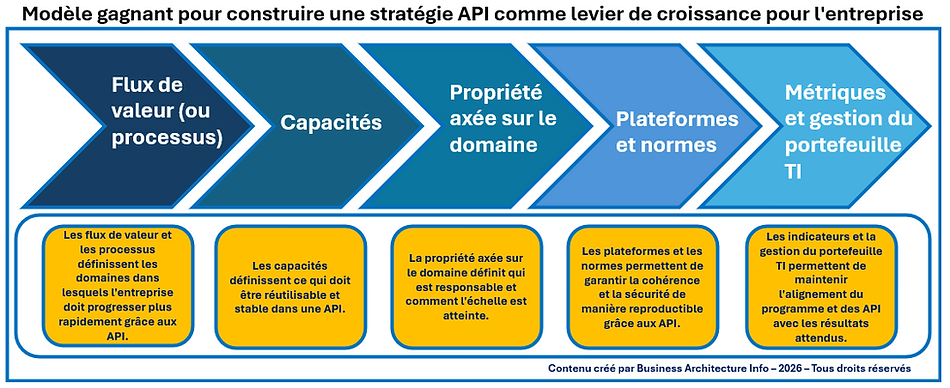
Élaboration d'une stratégie API comme levier de croissance
Les API (interfaces de programmation d'applications) sont souvent perçues comme de simples connecteurs techniques, nécessaires mais invisibles. Du point de vue de l'architecture d'entreprise, cette vision est incomplète. Les API constituent un mécanisme essentiel pour l'industrialisation des capacités métier, permettant leur réutilisation, leur composition et leur mesure à travers les flux de valeur, les processus métier, les produits, les canaux et les partenaires. Lorsqu'elle est ancrée dans des objectifs stratégiques, structurée par une cartographie des capacités et gouvernée par une responsabilité axée sur le domaine, une stratégie API devient un levier concret d'agilité et de croissance pour l'entreprise.
Une stratégie API de développement des capacités métier repose sur les résultats et se pérennise grâce à une conception basée sur les capacités, la responsabilité produit et la rigueur de la plateforme. Grâce à une gouvernance axée sur le domaine et à une valeur mesurable, les API évoluent d'intégrations ponctuelles à des ressources d'entreprise réutilisables. Bien conçues, elles accélèrent la mise en œuvre, soutiennent la modernisation, favorisent les écosystèmes et aident l'entreprise à s'adapter avec assurance.
Top 10 Enterprise Architecture Topics in 2025
Enterprise Architecture in 2025 isn’t about theory. It’s about real structural leverage. From AI to strategy execution, today’s EA leaders must bridge business intent with effective delivery, tame complexity, and institutionalize secure, data-driven, future-ready systems. The topics below, pulled directly from pages on BusinessArchitecture.info, reflect the most pressing challenges and opportunities for enterprise architects. They span practical leadership guidance, cutting-edge technology integration, strategic planning frameworks, and capability modeling that drives meaningful outcomes.

Création d'un modèle de capacité pratique à la fois descendant et ascendant
Les capacités métier sont au cœur de l'architecture d'entreprise car elles expriment ce que l'entreprise doit faire pour créer de la valeur, indépendamment de son organigramme ou de ses systèmes. Un modèle de capacités solide rend ses capacités visibles, stables et exploitables. Les meilleurs modèles sont construits selon une approche bidirectionnelle : la stratégie descendante définit le cadre, tandis que la réalité opérationnelle ascendante le valide et l'approfondit. Voici comment combiner ces deux perspectives, impliquer les parties prenantes, utiliser le contenu approprié et accélérer le travail grâce aux agents d'IA spécifiques à l'architecture d'entreprise.

Our New Enterprise Architecture Platform Partner: Ardoq
Business Architecture Info is now an Ardoq partner. Ardoq is the most flexible and intuitive Enterprise Architecture platform, built to help IT leaders map, analyze, and optimize their technology landscape. Ardoq's AI-powered automations, real-time insights, and dynamic visualizations replace static diagrams, enabling smarter, data-driven decisions.
Using Ardoq, Business Architecture Info helps organizations translate strategy into execution. We specialize in capability and value stream mapping, operating model design, and roadmap development that align change initiatives with business outcomes. Our team equips enterprises to prioritize investments, de-risk transformations, and deliver measurable value—faster.
Together, Ardoq and Business Architecture Info make a great team to increase the value of your enterprise architecture team.

Driving AI Innovation with Enterprise Architecture
Artificial intelligence is rapidly reshaping how organizations compete, operate, and deliver value. Yet despite its promise, many AI initiatives still underdeliver or collapse entirely. Enterprise Architecture (EA) provides a structured, business-aligned discipline capable of reducing this failure rate and accelerating meaningful innovation. By embedding EA rigor into AI programs, organizations gain clarity, alignment, and the ability to scale AI sustainably across the enterprise.
This article explores why AI projects fail, how enterprise architects can improve outcomes, what their involvement should look like at a project level, how EA brings coherence across multiple AI initiatives, and how an EA platform supports decision-making.

Sept concepts commerciaux que les architectes d'entreprise devraient maîtriser
Les architectes d'entreprise occupent une position unique. Ils se situent au carrefour de la stratégie, des opérations commerciales et de la technologie. Alors qu'un architecte informatique conçoit principalement des systèmes techniques, un architecte d'entreprise doit comprendre le fonctionnement de l'entreprise, la manière dont elle crée de la valeur et comment la technologie contribue à sa réussite stratégique. Le facteur de différenciation entre l'architecture d'entreprise et l'architecture informatique réside dans l'architecture métier, un domaine essentiel pour aligner la stratégie et son exécution. Les concepts suivants décrivent les compétences que tout architecte d'entreprise doit maîtriser pour exceller dans ce rôle stratégique.

Réduire la complexité informatique grâce à l'architecture d'entreprise
La complexité est inhérente à l'informatique d'entreprise moderne, mais une complexité non maîtrisée est un choix. L'architecture d'entreprise offre aux organisations la visibilité, la structure et la gouvernance nécessaires pour la gérer intelligemment. En se concentrant sur des capacités métiers sur mesure, l'architecture d'entreprise garantit que chaque décision technologique renforce la stratégie d'entreprise, et non la simple commodité technique. Elle aligne les personnes, les processus et les plateformes en un tout cohérent, favorisant à la fois l'efficacité opérationnelle et l'avantage concurrentiel.
Le message aux dirigeants est clair : simplifier ne signifie pas faire moins, mais faire ce qui compte le plus, mieux et plus vite. L'architecture d'entreprise est l'instrument stratégique qui transforme la complexité informatique en clarté, priorités, contrôle et valeur ajoutée durable pour l'entreprise.

How to Build a Unified AI Strategy with Multiple Vendors Using Enterprise Architecture
If you want a unified AI strategy with multiple vendors, do not treat each vendor as a one-off. You need enterprise architecture as the backbone to align business goals, design interoperable layers, enforce governance, and provide a roadmap and flexibility to evolve. Be disciplined. Build for interchangeability. Monitor relentlessly. And ensure every vendor decision serves the business architecture, not the other way around. You’ll then convert vendor multiplicity from a risk into a strategic advantage.

Why Enterprise Architecture Needs to Support Your Procurement Team
In digitally mature organizations, procurement of IT applications, hardware, data, and services is often treated as a purely tactical exercise. Yet business and enterprise architecture (EA) must be part of the conversation, or risk undermining long-term agility, coherence, and value. Many EA thought-leaders emphasize the discipline as a decision lens, not just modeling. By embedding EA into procurement, you turn purchases from discrete ballots into portfolio investments shaped by strategy, risk, and architectural consistency.

The Blind Spot of Application-Centric Thinking: Business Capabilities Matter
Application architecture remains vital, but it must support, not define, the enterprise. Without grounded capabilities, organizations risk investing in technology without achieving transformation. Linking applications to business capabilities, as shown below, creates transparency, strategic alignment, and measurable value. It shifts enterprise architecture from a technical exercise to a business discipline. In the end, sustainable success depends less on the software we deploy and more on the capabilities we choose to strengthen.

Gartner 2025 Hype Cycle: Why EA Without Value Streams Risks Obsolescence
In Gartner’s 2025 Hype Cycle for Enterprise Architecture, value streams emerge as the essential bridge between strategy and execution. Far from static blueprints, EA is now about influencing outcomes and shaping investments. Frameworks like SAFe® reinforce this shift, making value streams the backbone of planning and delivery. By focusing on value, enterprise architects can align technology with strategy, reduce friction, and embed themselves directly into agile business value realization.

Why Your Business Capabilities Are Superficial — And What It’s Costing You
Superficial business capabilities carry hidden costs—failed transformations, duplicated systems, wasted investments, and eroded trust. To succeed, organizations must ground their capabilities in strategy, validate them with experts, and decompose them to actionable levels. Done right, capabilities drive alignment, sharpen execution, and create the foundation for sustainable competitive advantage.

Planification stratégique à travers le prisme de l'architecture d'entreprise
L'architecture d'entreprise axée sur le client (CDEA) intègre stratégie, objectifs, capacités métiers et informatique pour apporter de la valeur au client et des résultats mesurables. Elle commence par la définition d'une orientation stratégique, d'objectifs mesurables et d'une architecture métier servant de passerelle vers l'exécution. Les initiatives stratégiques, les parcours clients, les flux de valeur et les capacités se traduisent en projets – commerciaux, informatiques et opérationnels – s'appuyant sur des architectures informatiques et des modèles opérationnels cibles. Cet alignement favorise l'agilité, l'efficacité et l'innovation, tout en améliorant la satisfaction client. Bien que sa mise en œuvre nécessite de surmonter les cloisonnements, les résistances et les lacunes en matière de compétences, la CDEA permet une croissance durable et un avantage concurrentiel.

Transforming Enterprise Architecture for Modern Digital Business Execution
In the face of accelerating digital disruption and rapidly evolving customer expectations, enterprise architecture (EA) practices are under pressure. Many remain constrained to rigid frameworks and centralized control models, resulting in operational stagnation and a lack of responsiveness. To stay relevant and add tangible value, EA must evolve. This means transitioning from static governance structures toward a dynamic, data-driven, and decentralized model, which needs to be embedded in the organization’s digital DNA and accelerates both strategic change and operational excellence.
This article outlines a three-tiered maturity model for transforming EA, progressing from basic operational governance to strategic transformation and ultimately enabling continuous innovation and improved ways of working.

10 Reasons Why GenAI Projects Fail - and How Enterprise Architects Can Fix Them
Generative AI (GenAI) holds immense promise for enterprise transformation, yet many initiatives falter due to common pitfalls. Enterprise Architects (EAs) are uniquely positioned to navigate these challenges by aligning GenAI projects with strategic objectives, ensuring robust data governance, and fostering cross-functional collaboration. By proactively addressing issues such as unclear goals, data quality concerns, and integration complexities, EAs can steer GenAI initiatives toward successful outcomes.

Leveraging Enterprise Architecture in IT Portfolio Management
In today’s fast‑paced business landscape, enterprise architects (EAs) hold a pivotal position in steering organizational priorities, ensuring that technology investments are not just reactive “nice‑to‑have” projects but strategic enablers that directly support business goals. Through structured frameworks, governance, and continuous evaluation, EAs optimize IT portfolios to deliver measurable value consistently.

The Architecture of AI Agents
The future of AI agents is not just a smarter version of today’s tools. It represents a fundamental shift in architecture, capability, and strategic value. With intelligent orchestration, continuous learning, advanced data integration, and human-centric design, these agents form adaptive ecosystems ready to operate at enterprise scale. As the speed of innovation outpaces internal development cycles, organizations are increasingly turning to specialized vendors for ready-to-deploy solutions. This shift is driven by the need for reliability, scalability, and strong ROI. To thrive in this AI-powered era, companies must embrace transformation, not through experimentation, but through architecture built for impact and sustainability

Crafting a Business Technology Use Case Using AI Agents
In today’s digital era, strategic business transformation through technology is not a luxury. It’s a necessity. As markets evolve and competition intensifies, organizations seeking innovation, agility, and operational efficiency must harness the power of artificial intelligence (AI), particularly AI agents. These offer a powerful means to enhance strategic planning and accelerate decision-making. This article presents a structured, three-phase methodology for crafting a business technology use case using our AI agents. Each phase guides organizations in stages from high-level corporate strategy to concrete delivery and execution, ensuring alignment between business objectives, customer value, capabilities, and technology solutions for impactful, customer-driven transformation.

Strategy Execution Operating Model
In today’s dynamic business environment, flawless execution is the bridge between strategy and sustainable success. Our Strategy Execution Operating Model provides a comprehensive framework to ensure strategic clarity, operational efficiency, and agile adaptability. By aligning strategy, operating models, and execution practices, organizations can achieve cohesive action across all levels. Through disciplined planning, cultural reinforcement, performance management, feedback loops, and risk mitigation, enterprises can confidently navigate complexity, drive continuous improvement, and realize their long-term vision with resilience and precision.

Enterprise Architecture Involvement Across the 7 Layers of AI Model Architecture
Business and enterprise architects play a pivotal role in shaping how AI is integrated and governed across the enterprise. Their involvement spans in all seven layers of AI model architecture from infrastructure to end-user applications, as shown in Figure 1. While their influence is limited in the more technical, infrastructure-focused layers, it becomes increasingly strategic as AI moves closer to business-facing domains. Architects need to align AI systems with business strategies, ensure interoperability, uphold ethical standards, and support scalability and compliance. By guiding AI development with a focus on value, usability, and trust, they ensure that AI investments drive meaningful outcomes and long-term business success.

Implementing Zero Trust Security with Enterprise Architecture
In today's complex digital landscape, traditional security models are no longer sufficient to protect against sophisticated cyber threats. As organizations expand their networks, adopt cloud solutions, and enable remote workforces, the attack surface increases, making security breaches more likely and potentially more damaging. This is where the Zero Trust Security framework becomes critical. Based on the principle of "never trust, always verify," Zero Trust requires strict identity verification, continuous monitoring, and least-privilege access controls. Implementing Zero Trust is a strategic move that not only enhances security but also supports organizational resilience and regulatory compliance. However, deploying Zero Trust is a multifaceted process involving significant planning, investment, and cross-functional collaboration that can be facilitated with enterprise architecture. This article explores the essentials of Zero Trust Security, the advantages and challenges it presents, the total cost of ownership, and the pivotal role that enterprise architects play in its successful implementation.

Addressing Technical Debt with Enterprise Architecture
Technical debt is an unavoidable aspect of modern software and IT systems, resulting from quick fixes, outdated technology, or suboptimal solutions that prioritize speed over long-term stability. While it can enable faster innovation in the short term, unresolved technical debt can lead to inefficiencies, higher operational costs, and security vulnerabilities. Organizations must find a balance between addressing technical debt and continuing to drive business growth. Enterprise Architects (EAs) play a key role in identifying, managing, and mitigating technical debt, ensuring it aligns with strategic business objectives. This article explores the impact of technical debt on operations, the reasons organizations accept it, and the best strategies for managing and mitigating its risks.

The Elaboration of a Modern TOGAF Architecture Maturity Model
Enterprise Architecture (EA) maturity is a critical factor in driving organizational success and alignment with business objectives. This paper presents a modern TOGAF Architecture Maturity Model, refreshing traditional approaches by assessing 10 key domains, as shown in Figure 1. Each domain progresses through five maturity levels, from initial, under development, and defined, to managed and measured. By integrating structured EA practices, strategic alignment, governance, security, and solution delivery, organizations can systematically improve their architecture capabilities. As businesses need to become more agile, this model enables them to evaluate, optimize, and measure their EA effectiveness, ensuring sustainable growth, agility, and adaptability in an increasingly complex and changing digital landscape.

A Comprehensive Approach to Enterprise Architecture and Solution Delivery
In today’s rapidly evolving business landscape, organizations must be adaptable and innovative to stay competitive. Enterprise Architecture (EA) and business architecture serve as the foundational framework for aligning business strategy with operational execution, providing a roadmap to deliver value and solve complex problems effectively. This article delves into the four key stages of EA and solution delivery, as shown in Figure 1 below: Enterprise Architecture, Solution Development, Implementation and Operation, and Continuous Improvement. Each stage plays a vital role in ensuring organizational success.

The Full Spectrum of Enterprise Architecture
Enterprise Architecture (EA) is a critical discipline that aligns business strategies with information technology, ensuring that organizations achieve their goals efficiently. The "full spectrum" of Enterprise Architecture provides a structured framework to connect strategic objectives with operational execution. It achieves this by bridging the gap between business and technology through distinct layers, each addressing specific aspects of organizational capabilities. This article explores these layers and their interconnections, focusing on the key elements of Business Architecture and Information Technology Architecture.

Your First 90 Days as Director of Enterprise Architecture
Taking on the role of Director of Enterprise Architecture (EA) in a 5,000-employee private organization is both a significant opportunity and a formidable challenge. The first 90 days are critical for establishing your credibility, understanding the organization’s landscape, and setting the stage for strategic, impactful, profitable, and transformative initiatives. This period should be focused on 10 main activities to learn, build relationships, and develop a clear vision and roadmap for your EA practice.

Selecting the Right Applications for Your Business Capability
In today’s fast-evolving business environment, the selection of the right application is critical for enhancing productivity, efficiency, and innovation for your organization. Applications are tools that allow businesses to execute tasks, manage data, and deliver products or services. However, the challenge of selecting and managing the right applications for your business capabilities can vary significantly depending on your situation. Here, we will explore how to select applications for your business capability under three common scenarios: 1- no application is currently supporting the business capability, 2- too many applications are supporting the business capability, or 3- there are not enough, or not the right, applications supporting the business capability.

How to Calculate Precisely the ROI of Your Enterprise Architecture Practice?
Calculating the Return on Investment (ROI) of an Enterprise Architecture (EA) practice can be challenging due to the complexity and indirect benefits it provides. However, a structured approach can help you quantify the ROI effectively. Read this article about the seven steps to calculate the ROI of your EA practice over a year.

Finding Quick-Wins Using Enterprise Architecture
While examining projects, it's tempting for enterprise architects to focus on major, complicated initiatives. However, pursuing quick wins is often a safer and more effective approach. Major projects frequently face delays, budget overruns, and often fail to achieve their initial business objectives. In the complex and rapidly evolving landscape of enterprise management, identifying opportunities that yield quick wins is a strategic imperative. These projects can deliver immediate value with minimal effort and resources, catalyzing broader organizational improvements. Enterprise architecture offers a powerful framework for pinpointing these opportunities, enabling organizations to align their initiatives with business objectives, optimize resource utilization, and enhance overall efficiency.

The Importance of a Modern Data Architecture for Successful AI Projects
Organizations are not limiting themselves to static IT-driven data architectures anymore, called data warehouses. They take too many resources to implement and change. Today’s data architecture needs to be ready for speed, flexibility, and innovation. The key to a successful data architecture upgrade is agility. As shown in Figure 1 below, modern data architecture may still include a data warehouse and data marts, but they need to be more flexible, adaptable, and agile. Read and learn more here.

Crafting Valuable Requirements Using Business Architecture and Artificial Intelligence
Planning, managing, and delivering business requirements are daunting undertakings in any organization. It requires a lot of human resources, and despite great efforts, the success rate of digital transformation project delivery is usually very low in most organizations. In this article, we’ll touch base on two methodologies that address today’s challenges of managing and crafting valuable business requirements, one of which is based on generative artificial intelligence.

The Place of Business Architecture within Enterprise Architecture
Business architecture, one of the four foundational domains of enterprise architecture, is too often neglected and even dismissed altogether in budget constraints. Rarely do enterprise architecture initiatives start with business architecture as they should. To succeed, an organization and its CIO(s) need to focus more resources on building and communicating business architecture change maps that will involve not just its enterprise architects, but also its business executives, its business architects, its product managers, IT portfolio managers, obviously its CIO(s), and all its short-term and long-term planning ecosystem.

Providing Value with Business Architecture and IT Architecture
Enterprise architecture needs sufficient resources to plan and map proper customer-driven business architecture, but the 3 domains of IT architecture should not be neglected, which are application/service, information/data, and technology/infrastructure.

Using Enterprise Architects to Increase the Success Rate of SAFe® Projects
Any organization with a digital transformation success rate lower than 50%[i] will find that it can improve this ratio substantially if they start using its enterprise architecture task force differently. To increase their value in an organization that uses SAFe® or any other sophisticated agile methodology, enterprise architects need to get a lot better at focusing on providing value to clients, patients, partners, key managers, and key employees using detailed value streams with identified participating stakeholders, enabling business capabilities, and last but not least, required information concepts.
.png)
How to Build a Grounded Capability Model
Business Capabilities are at the heart of an organization’s planning ecosystem. Capability mapping serves many purposes, two of which are critical. First, business capabilities are instrumental in setting priorities more quickly, focusing on the most profitable initiatives first. Second, a well-crafted and grounded, detailed capability-based roadmap allows agile project planning that is more accurate, less risky, and takes less time.

The 7 Phases of Strategy Mapping
Well-crafted strategic plans are mapped in detail from business design to agile solution delivery and execution to enable the necessary changes within an organization in response to customer needs, competition, and innovation. To achieve its strategies and goals, a firm needs to map and disseminate them cohesively throughout its organization using its entire planning ecosystems from executives, mid-level managers, strategists, business architects, enterprise architects, change managers, process experts, business analysts, and agile experts using the 7 phases of strategy mapping.

BOOK - Practical Guide to Agile Strategy Execution: Design, Architect, Prioritize, and Deliver your Corporate Future Successfully
"The book is loaded with some of the best visual models I have seen. The Strategy Execution Model alone is worth purchasing the book. Even if you are in an organization that you think is very “agile”, I would challenge you to read this book." -- Amazon Reader
