
By Daniel Lambert and Gwen Murphy
Organizations have never invested more in transformation[i]. Digital transformation, customer transformation, ERP modernization, operating model redesign, AI adoption, and business process transformation consume billions of dollars annually. Executive teams approve ambitious programs with the expectation that these investments will make their organizations more agile, customer-centric, efficient, and competitive.
Yet despite these investments, many organizations struggle to achieve the outcomes they envisioned. Projects are delivered. Technologies are implemented. Processes are redesigned. Transformation roadmaps are executed. Still, leaders often find themselves asking a difficult question: Why has so much changed, yet so little feels different?
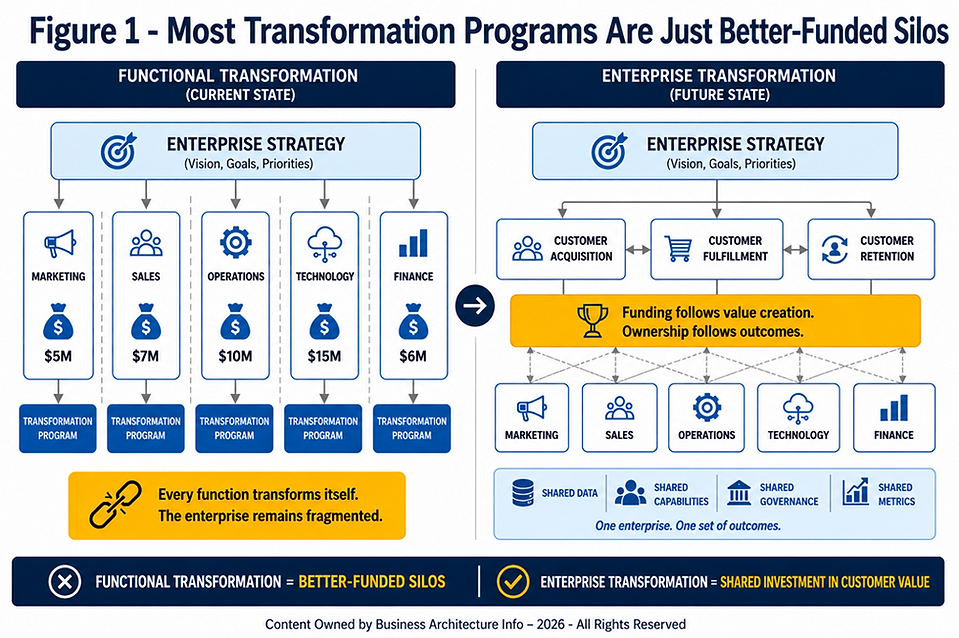
The answer lies in the distinction between functional transformation and enterprise transformation, as shown in Figure 1.
Most transformation initiatives focus on improving individual parts of the organization. They modernize systems, optimize processes, and enhance capabilities within existing organizational boundaries. While these efforts can generate local improvements, they rarely change how the enterprise creates value as an integrated system. True transformation occurs when strategy, capabilities, value streams, governance, investments, and organizational structures become aligned around enterprise outcomes rather than functional objectives. Achieving that level of alignment requires a perspective that extends beyond departments, projects, and organizational charts.
This is where Business Architecture and Enterprise Architecture become essential. Together, they provide the enterprise-wide framework needed to connect strategy with execution, align investments with business outcomes, and transform the enterprise rather than simply improving its individual functions.
Bigger Budgets, Same Behavior
Most transformation programs begin with legitimate business concerns. Leaders recognize that markets are changing, customer expectations are evolving, and existing operating models are no longer sufficient. In response, organizations launch large initiatives with dedicated funding, governance structures, and executive sponsorship.
What often remains unchanged, however, is organizational behavior.
Functions continue to pursue their own objectives, optimize their own performance metrics, and make decisions within their own boundaries. Technology teams focus on technology outcomes. Operations teams pursue operational efficiency. Marketing teams prioritize marketing goals. Each contributes to transformation, but primarily through a functional lens.
The structures that shape behavior remain largely intact. Departmental KPIs, funding accountability, reporting relationships, and decision-making authority continue to reinforce local optimization.
The result is a common paradox: organizations spend significantly more on transformation while operating much as they did before.
Projects may be completed, systems may be deployed, and milestones may be achieved, but customer journeys remain fragmented, and enterprise outcomes remain elusive. Transformation activity increases, while transformation impact remains limited.
Why Transformation Programs Become Silos
Silos are rarely caused by poor collaboration alone. They are typically the result of organizational structures, funding models, accountability mechanisms, and performance measures that encourage local optimization.
Unfortunately, transformation programs often inherit these same characteristics.
Many are established as large projects with defined budgets, sponsors, and scopes. Success is measured against project objectives rather than enterprise outcomes. Business units continue to develop their own roadmaps, compete for funding, and pursue separate transformation agendas.
Over time, transformation becomes a collection of parallel initiatives rather than a coordinated enterprise effort.
Technology integration can improve information flow, but it does not automatically align decision-making, incentives, or accountability. Organizations may achieve high levels of technical integration while remaining organizationally fragmented.
The fundamental issue is that transformation is often treated as a temporary program instead of a permanent enterprise capability. Programs end. Enterprise capabilities endure.
The High Cost of Funding Internal Competition
When transformation remains functionally driven, organizations often invest in multiple initiatives that pursue similar objectives from different perspectives.
The result is duplication, increased complexity, and slower decision-making. Multiple groups implement overlapping solutions, establish separate governance structures, and compete for the same resources.
Customers experience the consequences directly. While organizations are structured around functions, customers experience end-to-end journeys that cross departmental boundaries. Independent transformation efforts rarely eliminate the friction that exists between those functions.
Employees also become skeptical when repeated waves of transformation produce visible activity but limited operational improvement. This creates transformation fatigue and weakens confidence in future initiatives.
Executives face a similar challenge. Programs may be delivered successfully from a project management perspective while failing to generate meaningful enterprise value. When organizations confuse delivery success with business success, they continue funding initiatives that produce outputs rather than outcomes.
Stop Funding Functions. Start Funding Value
If transformation is to produce different results, organizations must move beyond a program-centric view of change.
The starting point is a shift in focus from projects to value creation. Instead of asking which function owns a particular initiative, leaders should ask which value streams, customer outcomes, and business capabilities require investment.
This change sounds simple, but it represents a fundamentally different way of managing the enterprise.
Shared outcomes must replace isolated objectives. Functions should be evaluated not only on their own performance but also on their contribution to enterprise-wide results. Governance structures should encourage collaboration rather than competition. Funding decisions should reflect strategic priorities rather than organizational influence.
This is where Business Architecture plays a critical role. Business Architecture provides an enterprise-wide perspective that connects strategy, execution, and operations. It helps leaders understand how capabilities, value streams, processes, information, and organizational structures interact to create business outcomes.
More importantly, it provides an objective framework for decision-making. Rather than funding initiatives based on the strength of individual business cases, organizations can evaluate investments based on their contribution to enterprise value. Instead of optimizing individual functions, leaders can optimize the system as a whole.
Cross-functional ownership is equally important. The most significant business outcomes rarely belong to a single department. They emerge from coordinated activity across multiple functions. Ownership models should reflect this reality and continue beyond the lifespan of individual programs.
Leaders seeking to dismantle silos should begin by examining how budgets are allocated, how success is measured, and how accountability is assigned. These mechanisms shape behavior more powerfully than any transformation roadmap. If they remain unchanged, transformation efforts will continue to reinforce existing boundaries. If they evolve, genuine enterprise transformation becomes possible.

Strategic Planning Through the Lens of Business and Enterprise Architecture
The challenge many organizations face is not a shortage of strategic planning. It is the inability to translate strategy into coordinated enterprise execution. Most strategic plans define ambitious goals, growth objectives, customer outcomes, and performance targets. However, once planning is complete, organizations often revert to managing change through projects, departments, and annual budgeting cycles. The result is a disconnect between strategic intent and operational reality.
Business Architecture and Enterprise Architecture help close this gap. Business Architecture provides a structured view of the enterprise through capabilities, value streams, information, products, services, and business outcomes. It enables leaders to understand what the organization must be able to do to execute its strategy successfully.
Instead of viewing strategy through the lens of organizational functions, Business Architecture views strategy through the lens of enterprise capabilities, as shown in Figure 2. This allows leaders to identify which capabilities are critical to achieving strategic objectives, where capability gaps exist, and where investments should be prioritized.
Enterprise Architecture extends this perspective by connecting business strategy to operational execution. It provides visibility into the relationships among business capabilities, processes, information, applications, technologies, and organizational structures. This enterprise-wide perspective helps organizations coordinate change across business units and investment portfolios.
Together, Business Architecture and Enterprise Architecture provide the bridge between strategy and execution. They enable organizations to:
-
Align investments with strategic priorities.
-
Prioritize capability development based on business outcomes.
-
Identify dependencies across initiatives and business units.
-
Coordinate transformation efforts across the enterprise.
-
Measure progress in terms of enterprise value rather than project completion.
-
Make informed investment decisions based on strategic impact.
Most importantly, they shift strategic planning from a budgeting exercise to an enterprise design discipline.
Instead of asking which department should receive funding, leaders can ask which capabilities must be strengthened to achieve strategic goals. Instead of managing a collection of independent transformation programs, they can manage a coordinated portfolio of enterprise change initiatives aligned to strategic outcomes.
When strategic planning is viewed through the lens of Business Architecture and Enterprise Architecture, transformation becomes more than a collection of projects. It becomes an enterprise capability for continuously aligning strategy, execution, investment decisions, and value creation.
This is the foundation of enterprise transformation.
Conclusion
Many organizations believe they have a transformation problem when, in reality, they have an alignment problem.
They invest heavily in projects, technologies, and change initiatives, yet continue to manage the enterprise through structures, incentives, and funding models designed for functional optimization. As a result, transformation efforts improve individual parts of the organization while leaving enterprise performance largely unchanged.
The solution is not more projects, larger budgets, or additional governance structures. The solution is to transform how the enterprise plans, prioritizes, funds, and executes change.
Business Architecture and Enterprise Architecture provide the enterprise-wide perspective required to make this possible. They connect strategy to execution, align investments with business outcomes, identify capability priorities, and enable leaders to optimize the enterprise as an integrated system rather than a collection of independent functions. Organizations that successfully transform understand that lasting change does not occur within organizational silos. It occurs when strategy, capabilities, value streams, governance, and investments are aligned around the outcomes the enterprise is trying to achieve.
Ultimately, organizations do not transform because individual functions become more efficient. They transform when the entire enterprise becomes capable of executing strategy, delivering value, and adapting continuously to change. That is the difference between transforming functions and transforming the enterprise.
_________________________________________
[i] For additional information, read “Investors overwhelmingly look to technology sector to fuel growth—but expect greater transparency on AI strategies and policies: PwC 2025 Global Investor Survey” published in December 2025 by PWC.