

By Daniel Lambert and Gwen Murphy
Enterprise Architecture platforms are changing. For years, their primary purpose was to provide architects with a structured repository for applications, technologies, capabilities, processes, and their relationships. That remains important, but it is no longer enough.
Generative AI and AI agents are pushing EA platforms toward a different role: not just systems of record, but intelligent architecture platforms that help people understand the enterprise, identify risks, evaluate alternatives, and automate parts of the architecture workflow.
Against that backdrop, Ardoq stands out. Not because it is the only EA vendor investing heavily in AI - SAP LeanIX and OrbusInfinity are doing the same - but because Ardoq combines a flexible graph-based architecture model with increasingly embedded AI, purpose-built EA agents, and governed access to architecture data from external AI tools. That combination makes it, in our view, one of the strongest foundations for AI-powered Enterprise Architecture.
1. Choosing an EA Platform: Your Technology Ecosystem Matters
There is no single EA platform that is the right answer for every organization. Your existing technology ecosystem should influence the decision, particularly when a vendor can offer meaningful integration with platforms already central to the enterprise.
If you are an SAP-centric organization using SAP S/4HANA, SAP Business Technology Platform (BTP), and SAP Signavio, your natural inclination will probably be toward SAP LeanIX. LeanIX is part of the SAP portfolio, and SAP has been tightening the connection between LeanIX and Signavio so that business-process and IT-landscape information can be synchronized. For organizations where SAP is at the center of transformation, that is a genuine advantage rather than simply a branding relationship.
Similarly, organizations deeply invested in Microsoft technologies may naturally gravitate toward OrbusInfinity. Orbus has long emphasized integration with Microsoft tools such as SharePoint, Teams, and Visio, allowing architecture work to connect with collaboration and modeling environments already familiar to business and technology teams.
If neither ecosystem is driving the decision, our preference is Ardoq. Most large enterprises are heterogeneous: multiple clouds, SaaS platforms, ERP products, legacy systems, data platforms, and now an expanding collection of AI services and agents. In that environment, a technology-agnostic EA platform can be a major advantage. Ecosystem alignment matters, but the more important question is whether the platform can represent the enterprise as it actually exists and convert that information into decisions.
2. Why Ardoq Stands Out from Other EA Platforms
Ardoq's strongest differentiators appear before AI enters the conversation. The platform is built around connected architecture data rather than static diagrams. Applications, capabilities, technologies, organizations, processes, projects, data, and other architecture objects can be linked through relationships in a graph-based model. Those relationships are often where the real value of EA resides.
Most important architecture questions are relationship questions. Which capabilities depend on an application? Which technologies support it? Which business units use it? What information does it process? Which initiatives will change it? What downstream impact would occur if it were retired? A connected model makes those questions easier to answer consistently.
Ardoq's flexible metamodel is another strength. Organizations can shape the model around the decisions they need to support instead of forcing every architecture practice into a rigid predefined structure. Dynamic viewpoints and visualizations are generated from the underlying data, so they can change as the architecture changes rather than becoming stale diagrams that architects must manually maintain.
The platform also combines surveys and distributed data collection, dashboards, scenarios, calculated fields, integrations, stakeholder-facing experiences, and strong relationship analysis. In our assessment, this combination is where Ardoq is superior to many traditional EA tools: it encourages EA to operate as a living enterprise knowledge base rather than as a repository maintained by a small architecture team.
3. Ardoq's AI Capabilities: More Than an EA Chatbot
The AI market has moved quickly, and it is no longer accurate to say that Ardoq is the only EA platform with sophisticated AI. SAP LeanIX now offers an Enterprise Architecture Assistant, AI-assisted architecture guidance, and MCP-based access from external AI environments. OrbusInfinity also markets an AI assistant, natural-language capabilities, AI-generated charts, and broader AI-driven features. The competitive bar has risen.
What makes Ardoq particularly interesting is the breadth of AI functionality being embedded directly into architecture work. Its AI Assistant can answer questions about live architecture data in natural language across multiple areas of the platform. Ardoq also provides AI-assisted query building, viewpoint creation, generated descriptions, business capability and value-stream modeling, process modeling, visual importing, and AI-assisted surveys.
More significantly, Ardoq has moved beyond conversational assistance into purpose-built EA agents. Its Custom Agents can execute predefined, multi-step procedures against the architecture graph and metamodel, producing structured outputs for specific EA tasks. AI-generated changes are designed to be governed: proposed updates can be staged in Scenarios so that an authorized person reviews and approves them before they affect the live architecture model.
This matters because useful EA AI must be grounded in architecture context. A general-purpose model may be able to write a plausible answer. An EA-aware assistant should understand the organization's applications, capabilities, dependencies, metamodel, permissions, and governance rules. Ardoq's direction is compelling because AI is increasingly being embedded into the architecture operating model, not simply placed beside the repository.
4. Where Native Ardoq AI Stops: The Cross-Enterprise Workflows We Still Need
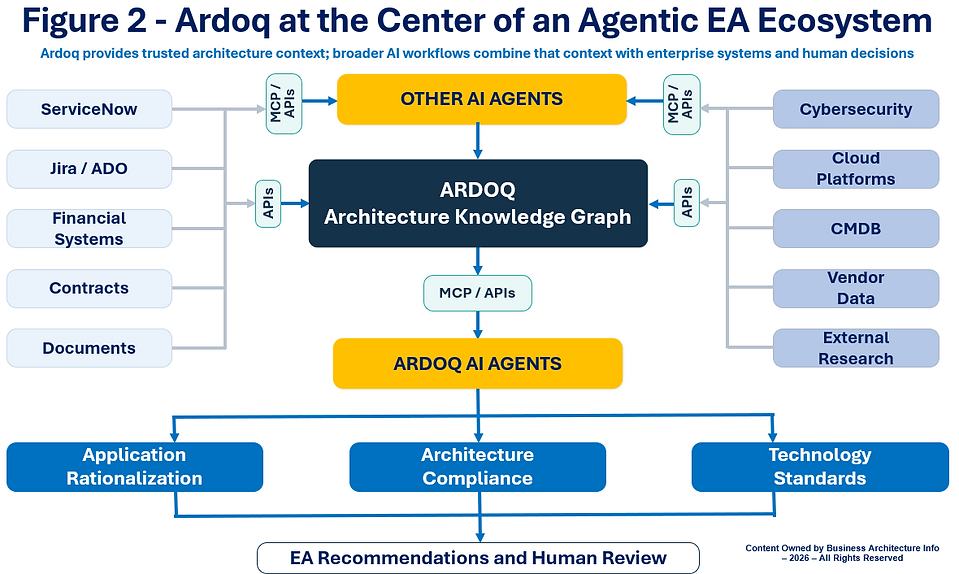
Ardoq's native AI is now capable of more workflow automation than it was even a year ago, so the limitation is no longer simply that it can answer questions but cannot execute EA work. Its purpose-built agents can already perform multi-step architecture tasks within the Ardoq environment, as shown in Figure 2.
The larger limitation is organizational scope. Many of the most valuable AI-powered EA workflows cross multiple enterprise systems. Consider application rationalization. A sophisticated workflow might combine architecture data from Ardoq with actual usage information, cloud or infrastructure telemetry, financial data, vendor contracts, software lifecycle information, cybersecurity findings, project data, and external market research. The agent could then score rationalization candidates, explain the reasoning, propose target-state actions, generate decision material, and initiate follow-up work in another platform.
The same pattern applies to technology standards management, solution architecture assessments, technical-debt analysis, acquisition due diligence, cloud migration planning, architecture compliance, and automated governance. These are not merely EA-tool workflows; they are enterprise workflows that use architecture as one source of context.
This is where Model Context Protocol (MCP), APIs, enterprise search, automation platforms, and external AI agents become important. Ardoq's AI Gateway allows external AI tools to use architecture data as governed context. The strategic opportunity is therefore not to make Ardoq perform every enterprise action itself. It is to make Ardoq the trusted architecture knowledge source that external agents can combine with other systems to execute broader workflows.
5. Implementing Ardoq as an AI-Powered EA Platform
The implementation lesson is straightforward: do not start with AI. Start with the architecture knowledge base.
AI cannot compensate for architecture data that is incomplete, inconsistent, outdated, or poorly structured. It can actually amplify the problem by turning weak data into confident-sounding answers. An effective implementation therefore begins with the metamodel: what information does the organization need, what relationships matter, who owns the data, and which decisions should the architecture support?
The next priority is authoritative data. Wherever practical, architecture information should be synchronized from source systems rather than manually re-entered into the EA platform. Ownership should also be distributed. Application owners, technology owners, capability owners, security teams, finance, and transformation leaders all hold pieces of the architecture picture. Surveys, integrations, and governed contribution mechanisms can help keep that picture current.
Governance matters, but governance should not become bureaucracy. The objective is not to collect every architecture attribute imaginable. It is to maintain enough trusted, connected information to support important decisions - and increasingly to give AI systems reliable context on which to reason.
That changes the design goal. You are no longer building an EA repository only for architects. You are building an enterprise architecture knowledge base that will be consumed by people, analytics, copilots, and AI agents.
6. The Verdict: Why Ardoq Is Our Preferred EA Platform
Selecting an EA platform is ultimately a contextual decision. For an SAP-centric enterprise heavily invested in S/4HANA, BTP, Signavio, and SAP-led transformation, SAP LeanIX is a compelling contender. For organizations that place exceptional value on deep integration with Microsoft collaboration and modeling technologies, OrbusInfinity deserves serious consideration.
Outside those ecosystem-driven cases, Ardoq stands out to us. Its flexible metamodel, graph-based architecture, dynamic viewpoints, distributed data collection, scenario capabilities, relationship analysis, and stakeholder-oriented experiences make it a strong EA platform even without AI.
Its AI direction strengthens the case. Ardoq now combines natural-language interaction, AI-assisted modeling and analysis, purpose-built EA agents, human-in-the-loop changes, and MCP-based access for external AI tools. We would not claim that Ardoq is objectively more sophisticated than every competitor in every AI category - the market is moving too quickly for that statement to remain defensible. We would say that Ardoq has assembled one of the most coherent AI-plus-architecture propositions in the EA market.
The larger opportunity, however, extends beyond Ardoq or any other single EA product. The next generation of Enterprise Architecture will not simply be an EA tool with AI features. It will be an environment in which trusted architecture knowledge can be used by AI agents to analyze change, coordinate work across systems, enforce governance, and support business decisions.
That is the direction in which Enterprise Architecture is heading. And right now, Ardoq provides one of the strongest foundations for getting there.
Editorial note: Vendor capabilities referenced in this article were fact-checked against current SAP LeanIX, Orbus Software, and Ardoq product documentation available in August 2026. Product capabilities can change rapidly.