
By Daniel Lambert and Gwen Murphy
Organizations have never invested more in transformation[i]. Digital transformation. Customer transformation. ERP transformation. Operating model transformation. Every year, billions of dollars are allocated to programs intended to make organizations faster, more customer-centric, and better prepared for the future.
Yet despite the investment, the results are often disappointing. Transformation programs launch with executive sponsorship, dedicated funding, specialized governance structures, and ambitious business cases. Teams work hard. New technologies are implemented. Processes are redesigned. Progress reports show milestones achieved and budgets consumed.
And yet, many organizations emerge from these initiatives looking remarkably similar to how they started.
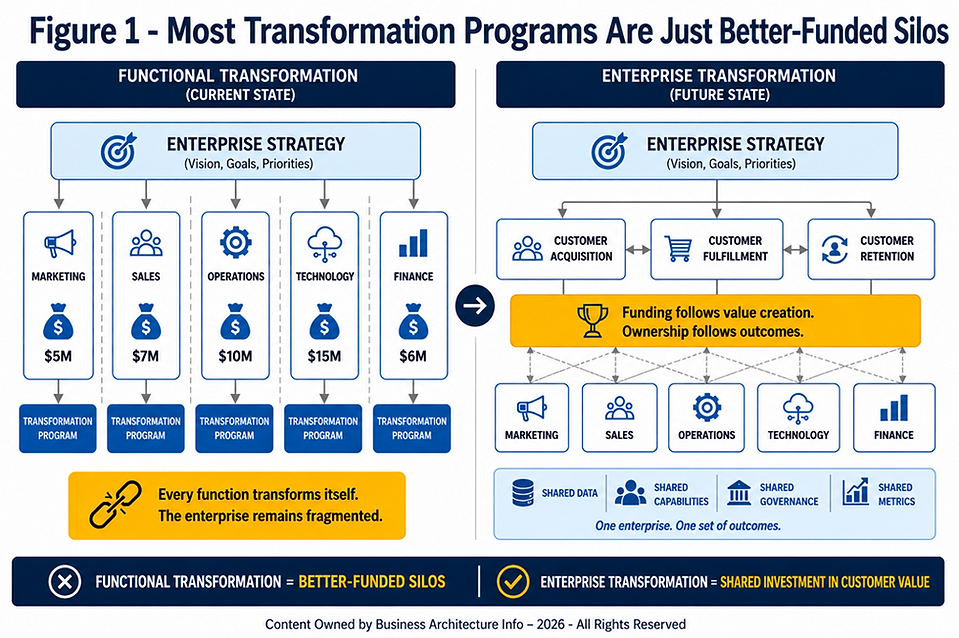
The reason is uncomfortable but important. Most transformation programs do not transform the enterprise. They modernize individual parts of it. They create new capabilities within existing organizational boundaries while leaving the underlying operating logic untouched. The result is not transformation. It is a better-funded version of the same siloed organization.
Real transformation occurs only when an organization changes how it operates across boundaries. It requires new ways of allocating resources, measuring success, making decisions, and delivering value. Without those changes, transformation programs simply become another mechanism for reinforcing the structures they were supposed to change.
Bigger Budgets, Same Behavior
Most transformation programs begin with good intentions. Senior leaders recognize that markets are changing, customer expectations are evolving, and existing ways of working are no longer sufficient. In response, they create dedicated programs with significant budgets and executive visibility.
On the surface, this appears transformative. Resources are allocated. Governance structures are established. Teams are mobilized. Consultants are engaged. New technologies are introduced. What often remains unchanged, however, is organizational behavior. Functions continue to optimize for their own objectives. Technology teams prioritize technology outcomes.
Operations teams focus on operational efficiency. Marketing teams pursue marketing goals. Customer service teams seek improvements within their own domain. Each group contributes to the transformation effort, but usually from the perspective of its own priorities and incentives.
The underlying structures that shape behavior remain largely intact. Departmental KPIs continue to drive decisions. Reporting relationships remain unchanged. Funding accountability stays within functional boundaries. Leaders are rewarded for optimizing their own areas rather than improving enterprise-wide outcomes.
This creates a paradox. Organizations spend more money on transformation while behaving exactly as they did before.
The evidence can be found in countless digital, customer experience, and ERP initiatives. New systems are implemented successfully, but customer journeys remain fragmented. Data is integrated, yet decisions remain disconnected. Processes are modernized, but organizational handoffs continue to create friction.
The problem is not a lack of effort. The problem is that transformation activity is often mistaken for transformation impact. Activity can be measured in projects completed, systems deployed, and milestones achieved. Impact can only be measured through meaningful changes in how the enterprise creates value. The two are not the same.
Why Transformation Programs Become Silos
Many leaders assume silos are the result of poor collaboration or outdated technology. In reality, silos are often the natural outcome of how organizations are structured, funded, and managed.
Hierarchy creates functional ownership. Funding models reinforce departmental control. Accountability frameworks reward local performance. Performance metrics encourage optimization within specific organizational boundaries.
Transformation programs rarely challenge these mechanisms.
Instead, they are frequently established as large projects operating alongside the existing organization. While intended to drive change, they often inherit the same structures that created fragmentation in the first place. Project-based thinking further reinforces the problem. Projects typically have defined scopes, budgets, timelines, and sponsors. Success is measured against project objectives rather than enterprise outcomes. As a result, transformation initiatives often become temporary structures focused on delivering predefined outputs rather than enabling lasting organizational capabilities.
Competing priorities among business units add another layer of complexity. Every function has legitimate needs and strategic objectives. Each develops its own roadmap and transformation agenda. Each competes for funding and executive attention.
Over time, transformation becomes a collection of parallel initiatives rather than a coordinated enterprise effort.
Technology integration is frequently presented as the solution. While integration is important, connecting systems does not automatically connect organizations. Information may flow more efficiently, but decision-making authority, incentives, and accountability often remain fragmented.
This is why organizations can achieve high levels of technical integration while continuing to struggle with organizational alignment.
The deeper issue is that transformation is often treated as a program rather than an enterprise capability. Programs have end dates. Enterprise capabilities endure. Programs deliver outputs. Capabilities shape how organizations operate every day.
When transformation is viewed primarily as a project, it becomes another silo competing for attention and resources.
The High Cost of Funding Internal Competition
The consequences of siloed transformation extend far beyond organizational inefficiency.
One of the most visible costs is duplication. Multiple functions invest in similar technologies, create overlapping processes, and pursue comparable objectives through separate initiatives. What appears to be innovation is often redundancy funded from different budgets.
Complexity increases as new solutions are layered onto existing structures. Instead of simplifying the enterprise, transformation programs frequently create additional governance forums, reporting requirements, and coordination mechanisms.
Decision-making becomes slower rather than faster.
Customer experiences also suffer. Customers do not experience organizations through functional structures. They experience them through journeys that cut across departments. When functions transform independently, customer journeys remain fragmented despite substantial investment.
Employees feel the impact as well. Many experience continuous waves of transformation with little visible improvement in how work actually gets done. New systems arrive. New processes are introduced. New terminology appears. Yet many of the underlying frustrations remain.
This creates transformation fatigue. Employees become skeptical of new initiatives because previous efforts produced activity without meaningful change. Engagement declines. Resistance increases. Future transformation efforts face greater challenges because organizational trust has been weakened.
Executives eventually feel the consequences too. Expectations are established based on ambitious business cases and significant investments. When promised outcomes fail to materialize, confidence erodes.
A critical mistake often contributes to this disappointment: organizations confuse delivery success with business success.
A program can be delivered on time, on budget, and according to scope while failing to generate meaningful enterprise value. From a project perspective, it succeeds. From a business perspective, it falls short.
When this distinction is ignored, organizations continue investing in transformation initiatives that produce outputs but fail to deliver outcomes.
Stop Funding Functions. Start Funding Value.
If transformation is to produce different results, organizations must move beyond a program-centric view of change.
The starting point is a shift in focus from projects to value creation. Instead of asking which function owns a particular initiative, leaders should ask which value streams, customer outcomes, and business capabilities require investment.
This change sounds simple, but it represents a fundamentally different way of managing the enterprise.
Shared outcomes must replace isolated objectives. Functions should be evaluated not only on their own performance but also on their contribution to enterprise-wide results. Governance structures should encourage collaboration rather than competition. Funding decisions should reflect strategic priorities rather than organizational influence.
This is where business architecture plays a critical role.
Business architecture provides an enterprise-wide perspective that connects strategy, execution, and operations. It helps leaders understand how capabilities, value streams, processes, information, and organizational structures interact to create business outcomes.
More importantly, it provides an objective framework for decision-making. Rather than funding initiatives based on the strength of individual business cases, organizations can evaluate investments based on their contribution to enterprise value. Instead of optimizing individual functions, leaders can optimize the system as a whole.
Cross-functional ownership is equally important. The most significant business outcomes rarely belong to a single department. They emerge from coordinated activity across multiple functions. Ownership models should reflect this reality and continue beyond the lifespan of individual programs.
Leaders seeking to dismantle silos should begin by examining how budgets are allocated, how success is measured, and how accountability is assigned. These mechanisms shape behavior more powerfully than any transformation roadmap.
If they remain unchanged, transformation efforts will continue to reinforce existing boundaries. If they evolve, genuine enterprise transformation becomes possible.
Conclusion
Transformation is often portrayed as a technology challenge, a change management challenge, or an execution challenge. In many cases, it is something more fundamental: an organizational design challenge. Funding alone does not create transformation. Executive sponsorship alone does not create transformation. New technologies alone do not create transformation.
Transformation occurs when organizations change the way they collaborate, allocate resources, measure success, and deliver value across functional boundaries. Many transformation programs fail because they leave these mechanisms untouched. They invest heavily in change while preserving the structures that limit it. They create new initiatives, new governance models, and new technologies, but they do not fundamentally alter how the enterprise operates. The result is a collection of better-funded silos.
Organizations that achieve lasting transformation take a different approach. They focus less on individual programs and more on enterprise capabilities. They align funding with value creation. They establish shared outcomes. They optimize the system rather than its individual parts. Ultimately, organizations do not transform when programs become larger. They transform when boundaries become smaller.
_____________________________
[i] For additional information, read “Investors overwhelmingly look to technology sector to fuel growth—but expect greater transparency on AI strategies and policies: PwC 2025 Global Investor Survey,” published in December 2025 by PWC.