
Architecting AI within Your Organization
How Enterprise Architecture turns AI ambition into business results

Most AI investments fail not because of technology, but because organizations lack the structure to translate ambition into execution. Unclear business outcomes, fragmented data, weak integration, and inadequate governance consistently undermine results. Enterprise Architecture provides the discipline leaders need to align AI with strategy, operating models, and accountability, ensuring AI initiatives deliver tangible business value.
As AI shifts toward autonomous, agent-based capabilities, architectural rigor becomes essential. Data architecture establishes trust and scale, while Enterprise Architecture enables interoperability across vendors, controlled adoption, and process-level integration. AI delivers results only when embedded into critical business decisions and measured by impact on speed, cost, risk, and performance—not experimentation or technology adoption alone.

Architecting AI within your organization requires moving beyond isolated models toward a coherent, enterprise-wide design. AI agents must be orchestrated, governed, and integrated across data, services, and decision flows. Enterprise Architecture provides the structure to ensure AI operates reliably, securely, and in alignment with strategic business objectives.
By embedding AI agents into core processes, organizations can transform data into actionable insight at scale. With strong data foundations, observability, and interoperability, AI evolves from experimentation into a repeatable capability. When architected correctly, AI delivers measurable improvements in performance, resilience, and decision quality across the enterprise.

AI initiatives consistently fail when leadership underestimates enterprise complexity. Unclear strategy, untrusted data, immature platforms, vendor-led decisions, and delayed governance prevent AI from scaling beyond pilots. These failure points are structural, not technical, and require deliberate executive ownership rather than isolated innovation efforts.
Enterprise Architecture provides leaders with the mechanism to correct these failures by aligning AI with strategy, operating models, and execution discipline. When architecture guides decisions, AI investments become coherent, governed, and outcome-driven—shifting AI from fragmented initiatives to a coordinated enterprise capability that delivers measurable business results.

AI is rapidly evolving from isolated, task-specific tools into autonomous, agent-based systems capable of reasoning, planning, and learning. These agents dynamically select tools, adapt to changing conditions, and improve through feedback. This evolution fundamentally changes how organizations must design, govern, and scale AI across the enterprise.
This shift demands architectural discipline rather than experimentation. Without clear orchestration, data foundations, observability, and governance, autonomous agents introduce risk instead of value. Enterprise Architecture provides the structure to integrate AI agents safely into operations, ensuring accountability, resilience, and alignment with business strategy as AI autonomy increases.

AI outcomes are constrained by data reality. Without reliable inputs and trusted outputs, even the most advanced models produce inconsistent, biased, or unusable results. Strong data architecture ensures accuracy, security, lineage, and accountability, giving leaders confidence that AI-driven decisions are explainable, compliant, and suitable for real-world use.
Effective AI requires data architecture that governs not only input quality but also output responsibility. As AI systems influence decisions at scale, organizations must manage bias, model drift, and regulatory risk. Enterprise-grade data architecture prevents AI from amplifying existing problems and enables sustainable, ethical, and value-driven AI adoption.
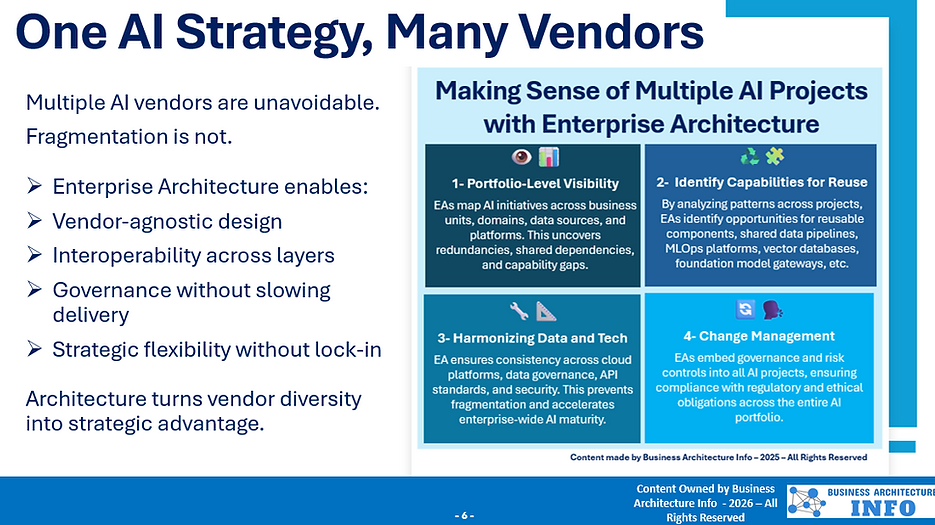
Multiple AI vendors are unavoidable in modern enterprises, but fragmentation is a leadership choice. Without a unifying strategy, organizations accumulate redundant platforms, inconsistent data, and unmanaged risk. Enterprise Architecture provides portfolio-level visibility, ensuring AI initiatives align with business priorities rather than individual vendor capabilities.
By enforcing vendor-agnostic design, interoperability across layers, and embedded governance, Enterprise Architecture turns complexity into flexibility. Leaders gain the ability to scale AI responsibly, avoid lock-in, and adapt as technologies evolve. Architecture transforms vendor diversity from an operational burden into a strategic advantage that accelerates enterprise-wide AI maturity.
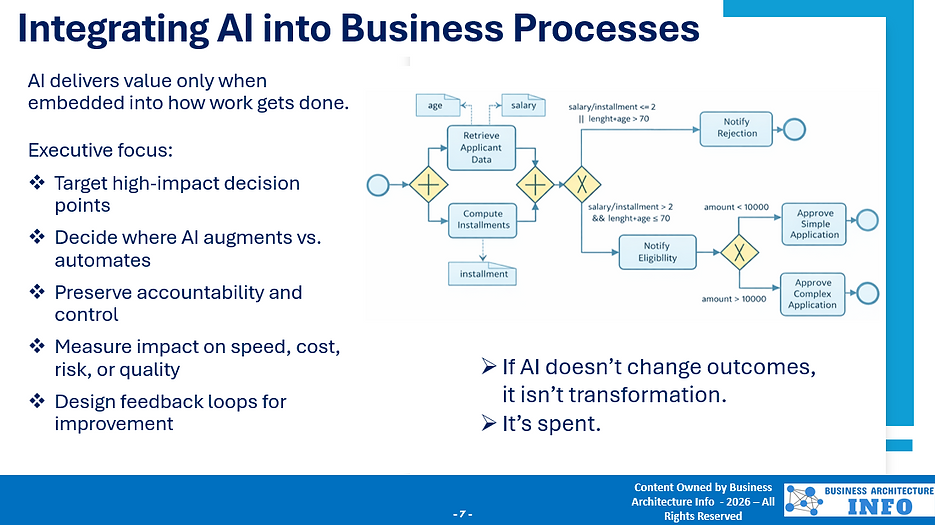
AI delivers business value only when it is embedded directly into core business processes. Standalone AI tools rarely change outcomes. Leaders must focus on where decisions are made, how work flows, and where AI can meaningfully improve speed, cost, risk, or quality without eroding accountability.
Successful AI integration requires clear choices about augmentation versus automation. Enterprise Architecture ensures AI fits seamlessly into process flows, preserves human oversight where needed, and establishes feedback loops for continuous improvement. When AI is designed into processes from the start, it becomes a durable capability rather than a one-off experiment.

Successful AI implementation follows a disciplined progression from strategic intent to operational execution. Leaders must begin with clear objectives, stakeholder alignment, and feasibility analysis before advancing into structured project planning, architectural design, and rigorous development. AI success is not accidental—it is built through deliberate planning and governance.
Execution requires controlled deployment, performance monitoring, and continuous improvement. From integration and scalability to compliance and model retraining, AI must be engineered as an evolving capability. Organizations that treat AI as a lifecycle—rather than a one-time project—create sustainable value and long-term competitive advantage.

AI delivers results only when ambition is matched with execution. Assessing readiness, closing architectural gaps, and focusing on near-term value ensure AI investments move beyond pilots and generate measurable business impact.
A focused 30-minute conversation can clarify where AI fits in your organization today. Identify practical opportunities, address structural barriers, and establish a clear, actionable path to turning AI into real business outcomes.